
Authority moved
See how measurement, forecasts, dashboards, and AI-supported recommendations stop describing the work and begin defining the choices available to people.
The System Is the Boss
How AI, Bad Data, and Broken Metrics Are Reshaping Work
How forecasts, dashboards, algorithms, and AI quietly replace human judgment, move accountability downward, and reshape who really holds power at work.
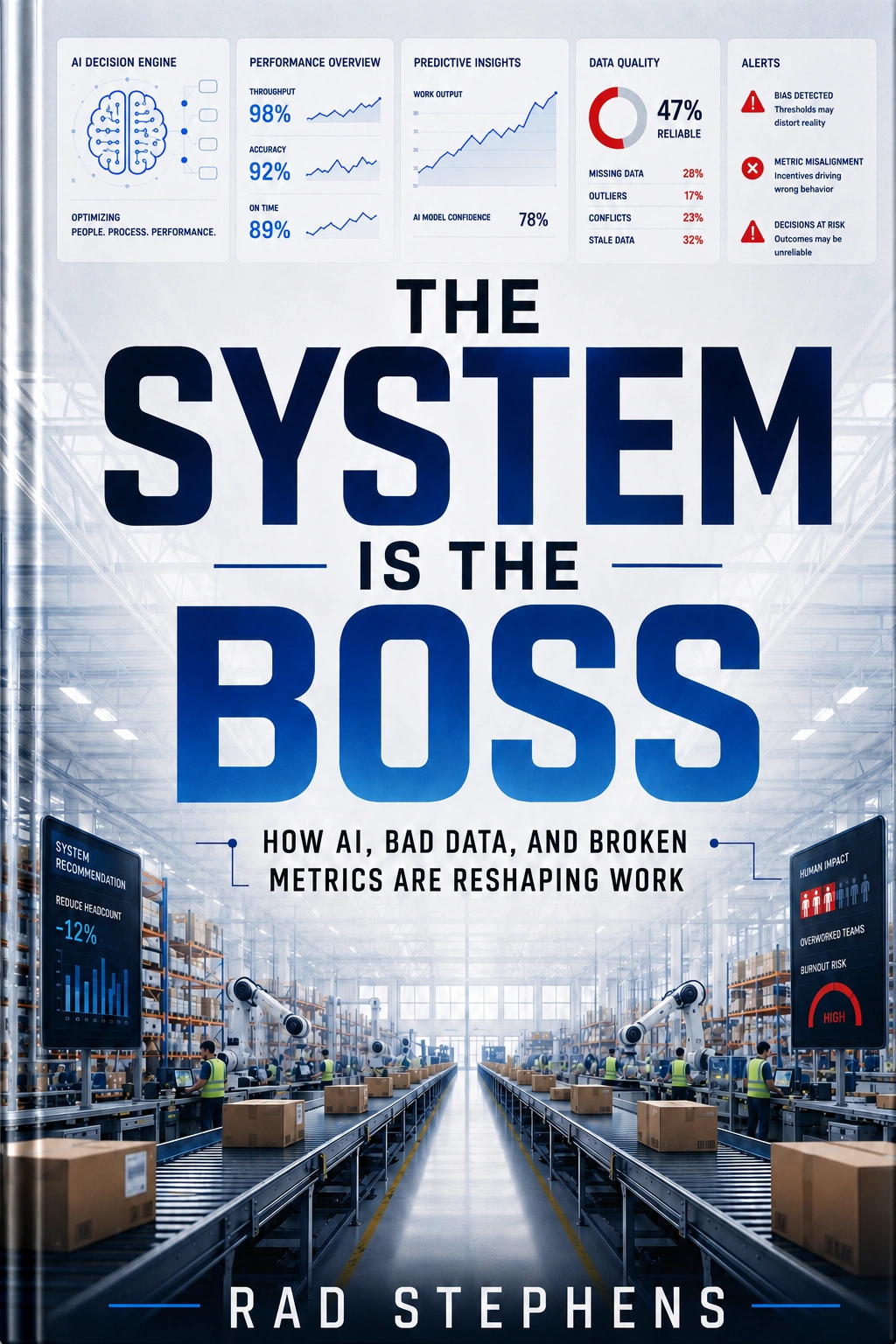
The org chart says a person is in charge. The workday often says otherwise. A forecast sets staffing. A labor system converts the forecast into a schedule. A routing model shapes the day. A dashboard turns an incomplete signal into a performance finding. By the time a manager, worker, or customer feels the result, the system has already defined what success looks like, what counts as failure, and whose name will be attached to it.
The System Is the Boss examines this quiet transfer of authority. Drawing on more than three decades inside large organizations, Rad Stephens shows how measurement moves from a useful tool to a governing force, how experience gets dismissed as anecdote, and how managers become the public face of decisions formed somewhere upstream. Through operational scenes and composite characters, the book follows the consequences onto the floor, into meetings, through performance reviews, and across the interconnected ecosystem of forecasting, labor, routing, and monitoring systems that increasingly acts before people arrive.
The book does not argue that data, metrics, or automation are inherently wrong. These systems solve real problems, improve consistency, expose blind spots, and allow organizations to operate at scale. The deeper question is what organizations traded away when they began treating system output as authority while continuing to describe people as the decision-makers.
Readers will see why responsibility moves downward even as authority moves upstream, why alignment can become a survival skill, why a human in the process may have neither time nor power to exercise judgment, and why the newest AI agents are accelerating a shift that began long before the language of artificial intelligence arrived. The System Is the Boss gives leaders, managers, workers, and technology professionals a clear structure for naming what they are already living inside, and for identifying the places where human responsibility still cannot be delegated.
See how measurement, forecasts, dashboards, and AI-supported recommendations stop describing the work and begin defining the choices available to people.
Understand why managers and workers become responsible for outcomes created by assumptions, models, and interconnected systems they did not control.
Identify the points where human discretion, dissent, and responsibility can still interrupt a system that has already started acting.
What readers will understand
How metrics, models, dashboards, and AI-supported tools move from informing decisions to defining which decisions are allowed.
Why accountability concentrates on managers and workers who execute outcomes but did not control the assumptions that created them.
Where human discretion, moral responsibility, and operational truth can still survive inside system-governed organizations.
For leaders, managers, frontline supervisors, operations and technology professionals, AI and data teams, human-resources leaders, consultants, policymakers, and workers who have felt the weight of carrying a decision they did not make.
Organizations are adding AI to workplaces that were already governed by forecasts, dashboards, targets, and automated workflows. The book helps readers recognize that the central issue is not only whether a tool is accurate. It is whether the tool has acquired authority, whether people can still challenge it, and who is held responsible when the system’s version of reality is incomplete.
Rad Stephens has spent more than three decades building, managing, and operating inside large organizations. His experience spans frontline work, multi-site operations, technology, data systems, quality, and executive-level decision environments, giving him a direct view of how authority changes as system output moves from recommendation to operating command.
Choose the edition that fits how you read, or compare all three books before deciding where to begin.